
Coaches Weigh in on AI and Its Promise in Leadership and Career Coaching
Forum Moderators: Jonathan Parker (JLPA President), Rachel Evans (JLPA Coach & Consultant), and Stephanie Koeshall (AI Consultant/Expert).
Forum Attendees: JLPA’s Coaching Community (Coaches and Consultants)
Introduction: In late 2025, JLPA’s coaches and consultants participated in a forum to explore how artificial intelligence (AI) is reshaping coaching, leadership development, and consulting—and how JLPA can engage AI thoughtfully while preserving the relational core of our work.
The Forum explored foundational AI concepts, practical coaching applications, ethical considerations, and real-world coaching experiences. Coaches in attendance found the session timely and useful, and expressed interest in continuing the dialogue to further strengthen their knowledge and skills for the benefit of JLPA’s clients.
Jonathan opened the AI Forum by warmly welcoming the JLPA coaching community and expressing deep gratitude for the collective impact JLPA coaches have had on clients. JLPA’s success, he emphasized, is rooted entirely in the expertise, care, and commitment of its coaches.
Embracing Change: A Call for Reflection
Jonathan urged coaches to engage in both introspection and outward observation. In an era marked by rapid transformation, spanning technology, artificial intelligence, leadership dynamics, and personal emotions, he emphasized the importance of staying open, flexible, and rooted.
“While change can be challenging, it is also vital. The JLPA community is particularly well-prepared to navigate and lead through these transitions.”
AI's Promise - 7 Key Forum Themes & Takeaways
1. Why Smart Leaders Will Expect AI-Powered Coaching
AI is emerging as a transformative force across industries and leadership landscapes, redefining how we operate and surpassing the notion that AI is a fleeting trend.
Today, leaders expect their coaches to be knowledgeable about AI, even if they aren't tech specialists themselves.
While the essence of coaching remains profoundly human—rooted in trust, presence, discernment, and relationship—coaches are now enhancing their practices with AI tools to better serve their clients and strengthen outcomes.
2. Empowering Coaches with Fundamental AI Literacy
AI expert Stephanie Koeshall offered an informative summary of key AI concepts, highlighting:
AI as a pattern-recognition tool, not a thinking entity.
Machine learning - the engine behind pattern recognition.
Large Language Models (LLMs), such as ChatGPT - systems trained on massive datasets to generate human-like responses.
AI’s strengths: speed, scale, summarization, synthesis, and pattern recognition.
AI’s limitations: hallucinations, outdated information, lack of judgment, and inability to predict the future.
AI was described as a “fast but imperfect intern”—useful but always requiring human oversight.
3. AI Literacy as a Strategic Leadership Capability
AI literacy is becoming foundational, like digital literacy or numeracy.
Government, education, and workforce systems are increasingly embedding AI into everyday operations.
Future leaders will enter organizations expecting AI-enabled environments, making AI fluency a core leadership capability.
4. How JLPA Coaches Leverage AI: Best Practice Examples
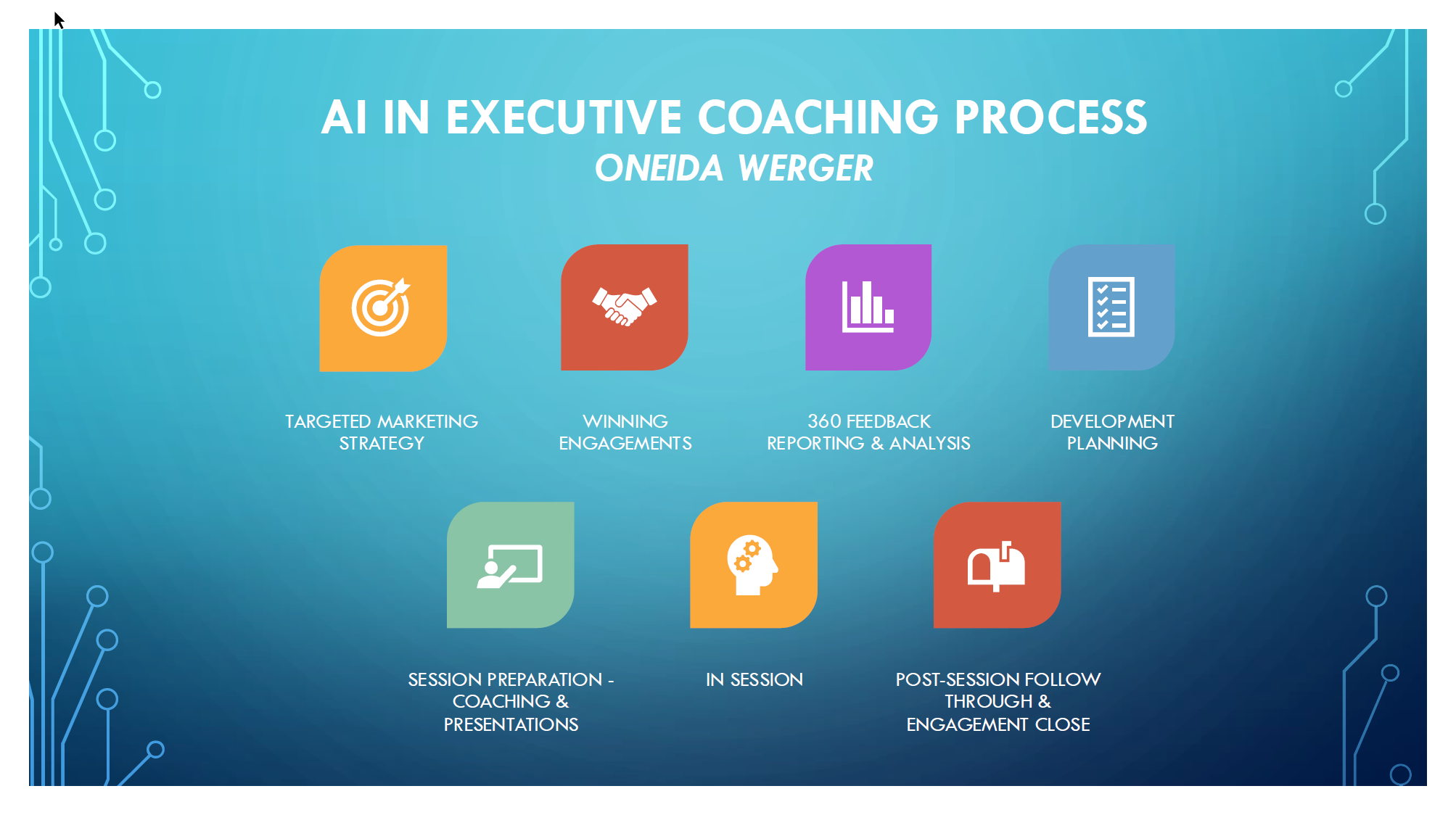
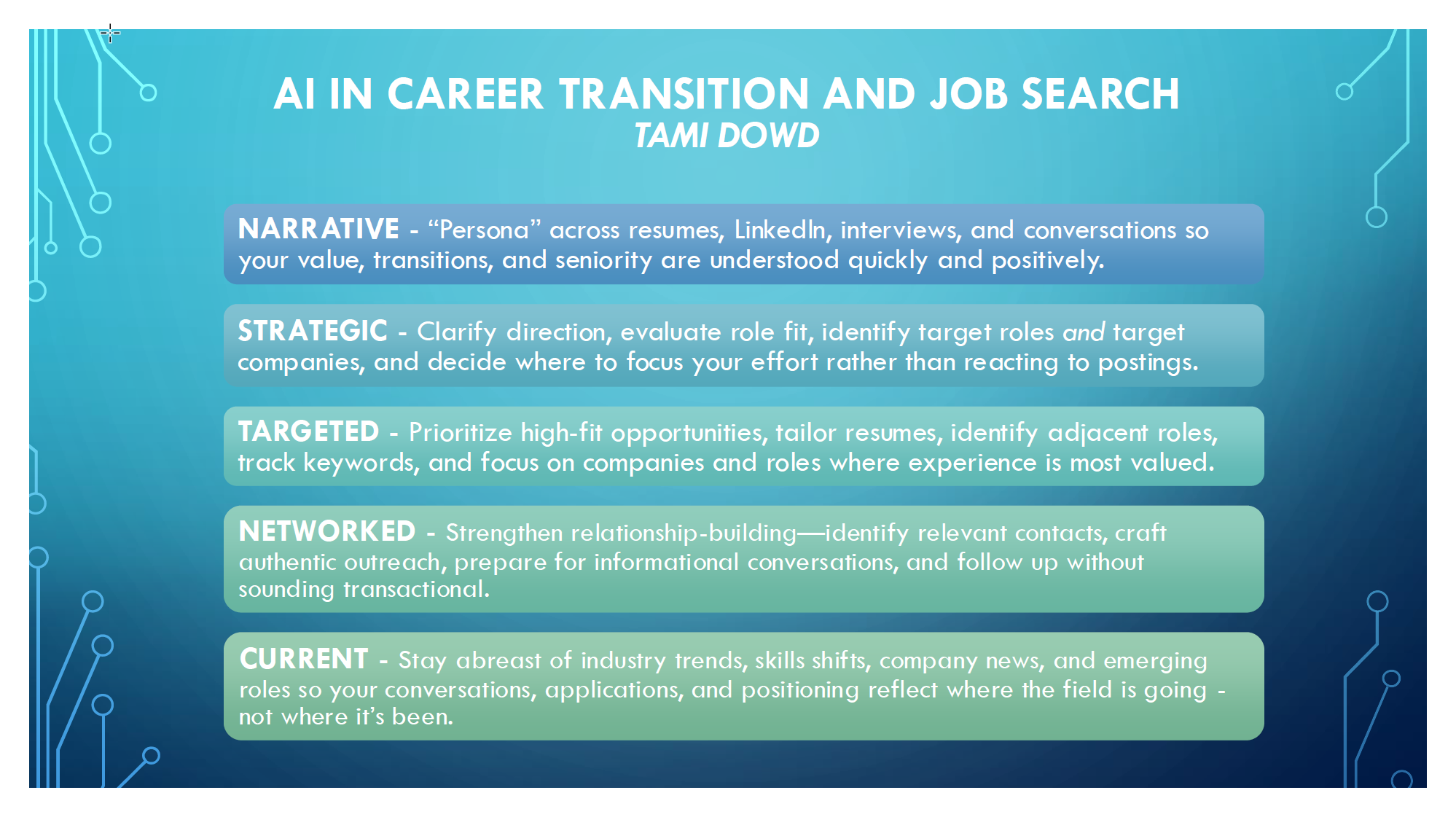
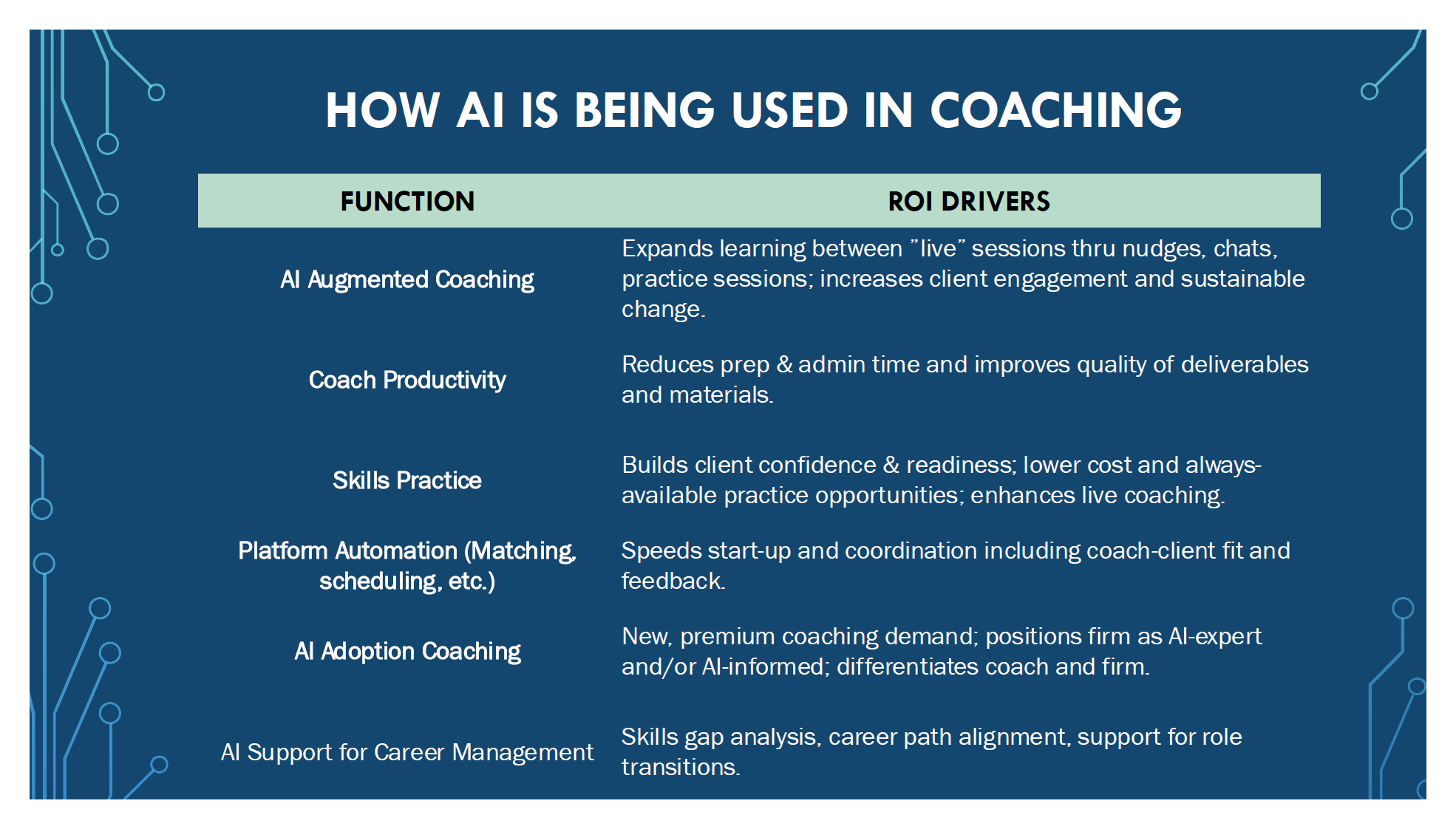
JLPA Coaches Oneida Werger and Tami Dowd shared insights on how AI is being leveraged in leadership and career coaching today. Examples are shown in the two slides below and include:
Preparing for chemistry meetings with unfamiliar client roles.
Generating industry-specific language and insightful questions.
Supporting the synthesis of 360-degree feedback.
Strengthening confidence and presence in client conversations.
AI was described as enhancing effectiveness without diminishing authenticity.
During the open discussion, attendees also shared real-world examples of how AI is already supporting their coaching work by:
Preparing for chemistry meetings and client conversations.
Synthesizing 360-degree feedback and leadership assessments.
Drafting development plans and coaching questions.
Generating reflection prompts and developmental activities.
Supporting insight generation between sessions
AI was described as increasing confidence, preparedness, and curiosity—particularly when engaging with unfamiliar industries or roles.
5. AI-Enabled Coaching Enhances Success While Maintaining Coaching Relationship
A consistent theme throughout the conversation was that AI enhances—but does not replace—the human coaching relationship. The most effective model is “Coach + AI,” where technology supports preparation, insight generation, and reflection while the coach remains the relational anchor.
Early indicators suggest:
Coaches who position themselves as AI-informed are gaining a competitive advantage.
Clients experience stronger outcomes when AI enhances rather than replaces human connection.
6. AI’s Risks, Ethics, and Guardrails
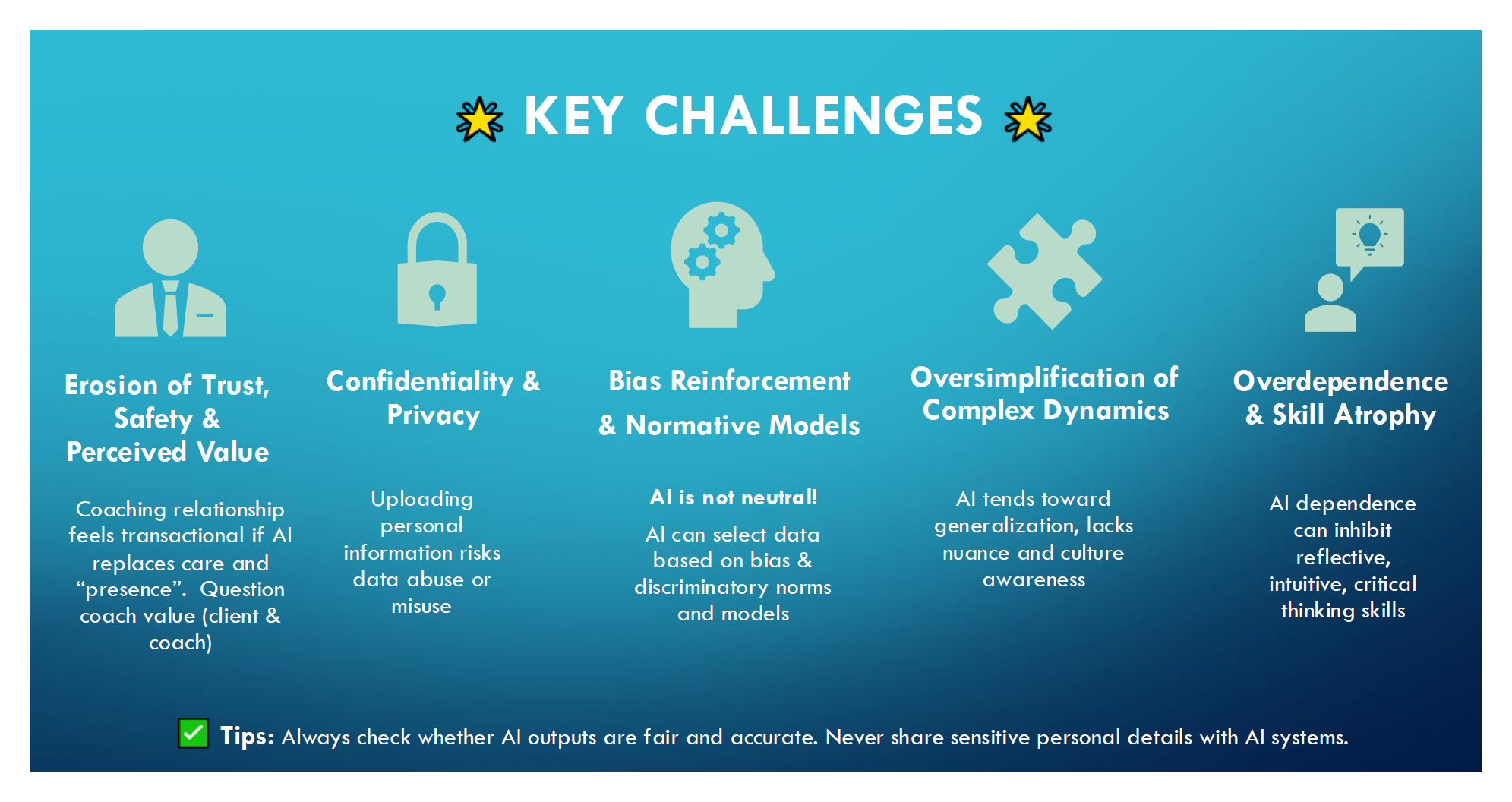
Erosion of trust if AI feels impersonal or transactional.
Confidentiality concerns when client data enters external systems.
Bias and oversimplification embedded in AI outputs.
Overdependence that may weaken human judgment.
Mitigation strategies discussed included:
Transparency with clients about AI use.
Avoiding identifiable client data in AI systems.
Treating AI outputs as drafts, not facts.
Maintaining professional discernment and ethical responsibility
There was consensus that JLPA should continue exploring shared ethical guidance around AI use in coaching.
7. Navigating the AI Future: Strategic Opportunities
Growth opportunities exist in career coaching, career transition, leadership development, and organizational change as AI adoption accelerates.
AI-informed coaching is becoming a market differentiator.
Clients increasingly expect coaches to understand AI’s impact on leadership, decision-making, and organizational change.
JLPA is well-positioned to lead by integrating AI thoughtfully while preserving deep human connection and trust.
Final Thoughts: Embracing AI as an Ally in Coaching
The Forum reinforced the belief that AI is neither a threat nor a replacement for executive coaching. When used with intention, ethics, and relational intelligence, AI becomes a powerful amplifier of human insight. Coaches can harness the power of AI by:
Familiarizing themselves with AI Concepts: learn basic AI terminology and technologies.
Exploring AI Tools: Research various AI tools and platforms that can assist in coaching.
At the practice level, JLPA is well-positioned to lead in this space by combining deep coaching expertise with thoughtful, responsible AI integration.